A riveting read about a single lone woman trying to navigate her way through life’s cruel challenges.
Team IWI reviews Louisiana Catch by Sweta Srivastava Vikram.
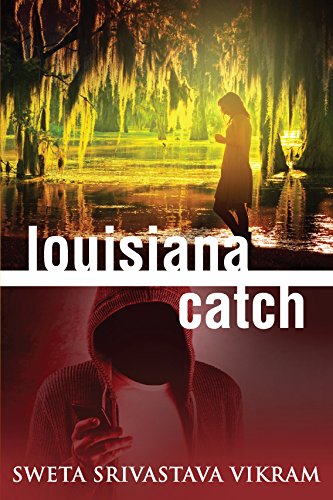 The book starts off on an emotional note with the first chapter itself and hooks the reader in. This fast-paced narration continues throughout the book taking the reader through the highs and lows that crop up in Ahana’s life.
As I read the book further, I found that there were a lot of similarities between Ahana’s life and mine. It helped me to relate to the story better and even impacted me deeply.
The protagonist’s relationship with her mother was very similar to what my mother and I share. Ahana’s mother reminded me of mine and what she would say in certain situations. It made me value my mother’s unconditional support even more.
Some of the incidents that Ahana experiences were also eerily close to what I’ve experienced. From overprotective parents to people who fail to appreciate the boundaries (an online friend who at first seems to get you like no other but later starts expecting too much attention), or first appearances that are soon proven incorrect (a colleague who seems sexist initially but is the only one who can magically make problems go away) or loved ones that cause grief and pain (like friends or partners who never bother about anything else but themselves).
Naina and Chutney won my heart over instantly while Rohan takes some getting used to. The quirkiness of Jay is well presented in the early pages and makes one wonder for a long time whether he is the right one for Ahana or not.
The social issues dealt with in this book are many-it helps that the author has closely inter-connected them and woven them into the plot so tightly that the various subplots don’t distract from the main storyline.
The instances of gaslighting are commonly prevalent but often it is dismissed as over-thinking. Likewise, in online interactions, the anonymity of the internet extends a certain sense of false security but it also adds an element of risk which we fail to recognize.
The writing is impactful and deep. There were occasions when I had to stop reading just to let the words sink in. Some of the powerful lines that have stayed with me are –
- What are you, Pavlov’s dog, Ahana?
- I had learned not to label people by their appearances.
- I never volunteered to be tied down or spanked but Dev never asked what I wanted.
- I dared to set boundaries. I dared to speak for myself.
- I wish you had taught me to protect myself instead of over protecting me, Mumma.
- The only way for a society to flourish was if women were free from violence.
The angle of domestic violence is a major part of the storyline and again is dealt with immense maturity and honesty. A very powerful statement that moved me was about the need for marital rape to be considered a crime.
‘Women raped by partners is sacrilege because in addition to the violation of their bodies, they are faced with a betrayal of trust and intimacy.’
This line called out to me because it makes for a strong statement and urges society to recognise marital rape as a crime.
The novel carries several important unforgettable lessons for all. (If anything, read this book to recognise those signs of domestic violence and/or emotional abuse.)
Kudos to the author for delving into the topics of marital rape, emotional abuse, online stalking and harassment with such sensitivity. Despite the novel dealing with such serious issues, the author never lets it become too taxing for the reader. There are ample instances of relief provided through Rohan’s banter or Naina’s sassiness. The balance of making a socially relevant statement and the entertainment value of a novel is well-maintained.
There were some aspects of the book that I think could have been done better. I found some instances of Ahana’s behaviour to be ridiculous-she knows she is being subjected to emotionally abuse but continues to participate in the communication, refusing to cut off contact with the perpetrator. It is annoying to see her turn a blind eye to all the glaring red flags that are staring at her in the face. Her stated reasons for being close to this person made no sense to me. But, I guess, that is exactly what emotional dependence is all about. One doesn’t want to offend the other person or give up something that is comfortable even if it poses a negative impact in some other way.
I also felt the editing could have been better. Some of the scenes were too wordy and less explanations would have made the storytelling more impactful. However, in some cases, it was this very level of detailing that made the reading more evocative too. So, I guess, it could be how one looks at it.
The book is a powerful read not just for the crimes against women but also for the important lesson it imparts-for all women to be emotionally self-reliant. It will provide those in need the much-required strength and inspiration.
Louisiana Catch, published by Modern History Press, is available worldwide on Kindle and as a paperback.
Did you enjoy reading the review? What are your favourite books on social causes? Share your thoughts and feedback using the comment box below.
*If you wish to write for IWI, head to our submissions page.
 INCREDIBLE WOMEN OF INDIA