More and more women authors have found their voices in recent years, and their stories have garnered a wide readership. While it is heartening to see publishers and readers give such unprecedented support to female authors, it is also admirable to note how women are increasingly writing about a variety of subjects, some of which are heart-warmingly honest and personal.
A first book that makes a splash and gets accepted by readers is never a fluke. The amount of work that goes into making a book publish-worthy is something that may not even be easily visible to an average reader. These writers have spent time honing their craft before attempting to strike out with a book that can carry on its own strength.
Debut authors, Anupama Jain, Tanushree Ghosh, Richa S Mukherjee, and Shuma Raha share their experiences and help decode the mystery behind writing and the success of their books.
Anupama Jain’s book When Padma Bani Paula is a tale about embracing second chances, getting up and striving full speed ahead.
Tanushree Ghosh’s collection of short stories, titled From An-Other Land – is also returning to your heritage to deal with the challenges that come with immigration.
Richa S Mukherjee’s novel, I Didn’t Expect To Be Expecting, is a rollercoaster ride through the challenges and hilarities of a typical urban couple preparing themselves for parenthood.
Shuma Raha’s book, The Love Song of Maya K and Other Stories, is a collection of short stories. ‘Set in Kolkata and Delhi, these stories are about love, sexuality, inner conflicts, secret resentments, disillusionment, aspirations and so on,’ she says.
Often, as part of the writing process, as the book evolves it takes on a different form than earlier envisioned.
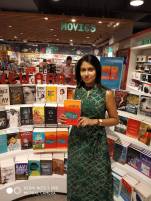
Tanushree Ghosh with her book at a prominent bookstore in Kolkata.
Tanushree agrees that she first started writing these stories as an attempt to bring the human stories of acculturation following immigration into a new country. Then, as immigration to the US and immigration as a concept became a target in the face of rising nationalism worldwide, the book slowly morphed into a manuscript exploring social issues in the US and the pertinence of immigrants from India.
What about the journey of writing and publishing? How did they manage the feat of getting the book out?

Richa Mukherjee with her debut book I Didn’t Expect To Be Expecting. Image Courtesy – Facebook
Richa thinks she was possessed by the well-meaning ghost of some writer. ‘How else can I explain finishing an entire book amidst diapers, incessant wailing, and zombie-like fatigue?’
Anupama likens it to a ‘surreal experience’ while Shuma describes it as ‘fulfilling’.
For Tanushree, the writing was the easiest, but she has painstakingly worked on improving her skills, as she ‘really wanted to learn the craft’.
Surprisingly, as difficult as the process of writing is, it is just as rewarding.
Richa agrees wholeheartedly. ‘Odd as it may sound, (at the time of writing) it was my me-time.’
Anupama considers writing to be therapeutic and liberating. ‘It has given me a new direction, a brand-new identity of my own and set me free from the gnawing angst of a floater.’
The post-writing phase can be the most challenging, though. Sending the manuscript out to publishers, bracing yourself for the rejection letters, and the endless wait to get your manuscript accepted is taxing and can take its toll.
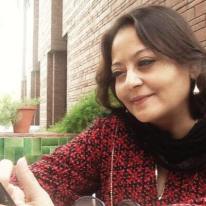
Shuma Raha, author of ‘The Love Song of Maya K and Other Stories’. Image Courtesy – Facebook
Shuma admits to the publishing part being ‘not quite as delightful’. She went ahead with Niyogi Books immediately, because she had heard that ‘publishers would not be interested in doing a book of short stories’.
Tanushree calls it ‘a whole new beast’, altogether, and although she admits there is great learning in all of it, she warns, ‘it might not be for the faint of heart – at least some parts’.
And yet, despite having gone through the whole grind there’s nothing else Anupama can imagine ‘other than telling stories and hoping for resonance from the readers’.
Richa admits the process was easier for her because she had immense support (from author Ravinder Singh, who she now calls her pal and mentor, and the team at Harper Collins) and that is what made the journey ‘beautiful and memorable’. She shares an anecdote about the first day after the book was out in the stores. ‘I walked into a store and saw my book displayed, I signed it, posed for a picture, walked to a corner and cried tears of joy. There is nothing that can replace that feeling of pride and joy when you see your baby, all pruned and nourished, sitting in a book shelf.’
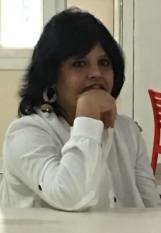
Anupama Jain, blogger and author
Anupama lists a number of such highs that she experienced during the process of bringing this book out. ‘The first such moment was when my editor sent me an email saying, ‘This version is good to go!’ The second and third were after the book was out – when I held a printed copy of my novel for the first time, and then again, when I saw copies of my novel in a bookshop for the first time.
There are low points, too, and any writer has their own share of obstacles to overcome.
Tanushree says it was the PR that she finds the most difficult to deal with; while, for Anupama and Richa, it was the self doubts. ‘Once I started re-writing, editing, receiving and incorporating feedback, I would berate my efforts – the logic, the language, everything,’ Richa explains.
For Shuma, it was the tussle of publishing that was the most challenging. ‘The details are boring. Suffice to say that as a debut author you don’t quite get the treatment you ought to get from your publisher.’
The moments of self-doubts, the struggles involved in promoting the book, the lows that are sometimes dismal and exacting, have probably taught them valuable lessons. In retrospect, would they do anything differently, now that they know what it involves?
The authors are vehement in their denial of wanting to change anything, but each adds what they would like to do better.
Anupama credits the journey for sharpening her skills but also emphasizes on the importance of reading.
‘This is a learning journey. Also, I am pretty sure that once you get in the flow and things start evolving, there aren’t many U-turn options,’ Tanushree says.
Richa agrees. ‘Everything that happened on this journey had a role to play towards this end. Had I not allowed myself to be tossed along with the tide of my circumstances, I would not even have written this book, let alone publish it.’
Hearing such deep insights, I am confident, they’d be happy to write again.
As we embark on a new year, we hope for more stories, more laughter, and more books from female authors.


 INCREDIBLE WOMEN OF INDIA