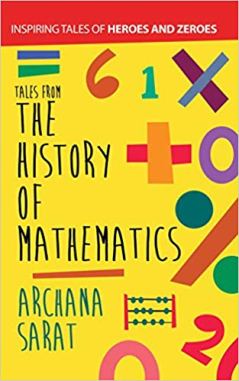
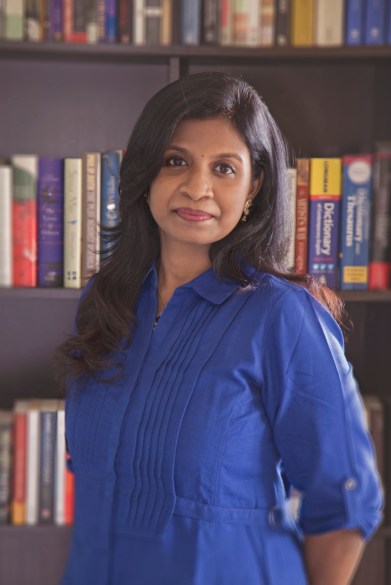
Archana Sarat is a multi-dimensional author and a recent awardee at the REC-Valley of Words Literature Festival, Dehradun for her remarkable book Tales from the History of Mathematics. A fascinating blend of anecdotes and facts, this book charts the important milestones in the evolution of art and science of Mathematics and brings its journey to life.
Our Managing Editor, Indrani Ganguly, has an interesting chat with Archana about this calculatingly fun title that won in the ‘Best Writing for Children/Young Adults’ category.
Indrani: Hello Archana. Congratulations! Your book Tales from the History of Mathematics has just won the award for the ‘Best Writing for Children/Young Adults’ at the Valley of Words literature festival, Dehradun. How does it feel?
Archana: It is a surreal feeling to be recognised organically among thousands of competing books. Some of the other winners of this award have been writing stalwarts like Jerry Pinto, Anjum Hasan, Hindol Sengupta, Namitha Gokhale — I am a huge fan of their work. I am humbled and thankful I had the opportunity to share the stage with them.
Indrani: Mathematics is a subject that draws extreme reactions from people especially kids. They either love it or hate it, mostly the latter. What made you consider writing on this subject?
Archana: I have always loved this subject. All through my school and college years, I have either scored a centum or close to a centum in this subject. However, I had never given a thought to the evolution of this subject. It was serendipity that led me to research this topic. The more I delved into this topic, the more it sucked me in and the book was a consequence of that!
Indrani: You are a qualified Chartered Accountant. Were you always in love with numbers?
Archana: Yes! I had wanted to do my PhD in Mathematics. However, hailing from a family of Chartered Accountants in Chennai meant that I was sent off to my CA classes after twelfth, which was as natural to my parents as sending a child to first grade after kindergarten.
Indrani: Your book amalgamates mathematics and history in an extremely fluid and engaging way through facts as well as anecdotes. How much research did you have to do before penning this book?
Archana: Immense! I have always liked to research and learn new things but researching the history of mathematics was challenging. There was so much to know but so little reliable sources. I spent more than a year researching and writing this book.
Indrani: Mathematics is as vast as the universe itself. How did you plan on encapsulating the huge spectrum of the subject in 26 stories? How did you pinpoint on what topics and concepts you would cover?
Archana: My book is just the tip of the iceberg. There is so much more to the topic that even 26 books might not be enough. I had given myself three rules to decide which are the topics and stories that I would cover:
A. Would it be of interest to the reader?
B. Does it add anything new to their knowledge of mathematics/ history?
C. Would it be inspiring and engaging?
Even with these rules in place, the stories that came up were innumerable. I had to let go of many, in the hope that I could always do a sequel.
Indrani: This book has been loved and appreciated by both children as well as adults. That is quite a feat. Did you expect that kind of feedback?
Archana: Honestly, no. I wrote this book for adults at first. It was my publisher who felt that these stories would be equally enjoyed by children. My kids were also keen that I write a book which they could enjoy too. Since my first book was a dark, psychological crime thriller, they weren’t able to read it. All this sent me back to the writing desk and I reworked the stories to appeal to anyone between 8 and 88 years of age.
Indrani: What are the measures that you think parents and educators can take to make a dry subject like Mathematics more enjoyable for children?
Archana: First, I wouldn’t agree that mathematics is a dry subject. In my opinion, there is no subject more interesting than mathematics. If a child doesn’t enjoy the subject, it is only the fault of the parents and teachers. Parents, who did not perform well in the subject, subconsciously pass on their fear of the subject to their children. Teachers teach the subject focused on examinations and syllabus. Rarely do the children get an opportunity to simply play around and explore with numbers. One thing that parents and teachers could do is help their children understand the concepts rather than focus on their marks.
Indrani: India has always had supremacy in the field of Mathematics since the Vedic times. We introduced zero to the world. Do you think our methods are more scientific?
Archana: India’s biggest gift to the world is the Indian Decimal system, with the notational placement values. When you couple this with India’s discovery of zero, it is evident that our country has changed the entire scenario of how the world looks at numbers. The Greek and Roman number system were not evolved enough to deal with complex calculations. The Indian decimal system, with a distinct symbol for all numbers from 0 to 9 along with a place value for each number, is so simple and feels so natural that we sometimes forget how important is its invention to the development of the world. India not only invented zero and the notation to show zero, but it was also the Indian mathematician, Brahmagupta, who first started calculating using zero. Till then, zero was just a placeholder to decide if a number was 20, 230 or 203.
When trade between Arab kingdoms and India flourished, Indian mathematicians and accountants understood that the Arab number system was not evolved enough. The need for a common system was pressing. So, a group of Indian mathematicians went to the court of the Caliph and explained and recited Brahmagupta’s work. Impressed, the Caliph ordered the work to be translated to Arabic. From there, the decimal system travelled to the western world through the works of the Italian mathematician, Fibonacci. Hence, it got the name, Hindu-Arabic numerals. Until this historical event, no significant mathematical or scientific progress happened in the western world.
After that, when we were oppressed under British rule, our education system changed into a method of training people for clerical jobs. Sadly, we have still not completely recovered from that. Our educational system needs a complete overhaul if we are to shine in the field of mathematics once again.
Indrani: Readers feel an immense sense of pride in our mathematical legacy after reading your book. Was that also something that you aimed at while writing?
Archana: Yes, it was certainly the intention that readers should be aware of the immense early contributions of India to the development of modern Mathematics. Our early mathematicians like Aryabhatta, Brahmagupta and Bhaskara put their work ahead of their personal glory. While this is an admirable trait, it leaves huge gaps in historical contributions. I had hoped my book could fill a bit of that gap.
Indrani: Like you say in the book: ‘You are already a mathematician,’ do you feel that one does not need to be a subject matter expert or number lover to appreciate and love this book? This book can also be used as a teaching supplement by math teachers to make the subject more appealing and fun for students. Don’t you think so?
Archana: Definitely. The beauty of Mathematics could be appreciated not only by solving problems but also by its history—the extent to which early Mathematicians made enormous sacrifices, sometimes paying with their lives, for the advancement of the subject. Hippasus, who discovered irrational numbers, was thrown into the sea. Galileo, who said that the sun was the centre of the universe, was placed under house arrest by the Church. Hypatia, the first woman mathematician in the world, was murdered in public. Archimedes was killed by a Roman soldier for the role that his engineering marvels played during the war.
The book will be fun and appealing for children, as I have presented the history in the form of stories, supplemented by a ‘Know More’ section, which gives more factual context to each tale.
Indrani: What next? Can we expect a sequel to this book? Surely there are many many more mathematical stories to tell.
Archana: Researching into the history of Mathematics led me to know more about the history of sciences in general. There are definitely many more sequels and series coming up.
Indrani: Finally, how many of your math-hater readers have you managed to convert with this wonderful book?
Archana: Many readers, both young and old, have told me that reading the book has opened their minds to the interesting facets of the subject. Even if one of my readers develops a new liking and interest in Mathematics, I will consider my purpose achieved.
Archana Sarat’s Tales from the History of Mathematics is available online and in all major bookstores.
Archana Sarat is the author of Birds of Prey, an acclaimed psychological crime thriller in the process of being adapted to the screen. Her other book, Tit for Tat, is a collection of flash fiction stories. Her articles have been widely published in various popular newspapers and magazines. Her short stories and poetry have appeared in various magazines and anthologies.
She is the Founder of Read Write Inspire (https://readwriteinspire.com), a writer’s studio
filled with resources towards a strong author platform. She is popular in the online world for her flash fiction that appears every Saturday, called Saturday Shots. Though she is a Chartered Accountant by qualification, she took up her childhood love for writing as her vocation. She hopes her writing can inform, educate, impact and entertain at the same time.
You can connect with her at http://www.archanasarat.com
 INCREDIBLE WOMEN OF INDIA