I met Narayani Sahu in Feb 2018. She was part of 100 Ujjwala customers from various parts of India who were invited by the President of India to share their experience of switching to a cleaner cooking fuel- LPG from biomass-based fuels. She stood in the majestic Durbar Hall of the Rashtrapati Bhawan and said,
“वैसे तो समय कोई नहीं खरीद सकता लेकिन उज्ज्वला से ऐसा लगता है कि जैसे हमने समय ही खरीद लिया है”.
“People say that time cannot be bought but with Ujjwala it feels like by buying a cylinder we have bought time.”
When she finished telling her story the whole of Durbar hall was clapping in applause. Narayani and I speak on the phone off and on. I spoke to her a month back to check how she was doing during the COVID 19 pandemic. She told me that she and her women friends in her village in Chattisgarh were doing alright. She had received money from the government in her Jan Dhan account. She had also received money for getting a free cylinder. She said that in such difficult times, they really feel a sense of relief that the money is coming in their bank accounts. She had begun work in MGNREGA- Employment Guarantee Act. She and her husband own a farmland and they had just harvested the summer paddy. Her 18-year-old daughter is studying. Narayani makes sure that she has an uninterrupted supply of LPG in her kitchen.
Almost three years back, I met some very articulate women in the villages of districts of Khagaria and Darbhanga in Bihar. They all used to collect fuelwood from farms or any nearby jungles. With Ujjwala, they had all switched to LPG. Sample some of their words:
“चार घंटा लगता था एक बार में जलावन इकट्ठा करने में, कभी दो बार भी जाना पड़ता था। वापिस आने तक मौत आ जाती थी; चेहरे काले रहते थे। अब पता चलता है कि कुछ हैं हम लोग भी”
“When I went out to collect fuelwood, each trip used to take four hours, some days I had to go twice. By the time I used to come back I was dead tired. Now with the LPG gas connection, I feel my social status has gone up”.
– Pramita Devi, Village Laxminiya, Block Khagadiya, District Khagadiya, State Bihar
“अब सब बहु–बेटी हाई स्टैण्डर्ड हो गए हैं। चूल्हे में कोई हाथ नहीं काला करना चाहता है । गैस आने से सब सुकुमार हो गए हैं।“
“Now our daughters and daughters-in-law have high standards. They don’t want to blacken their hands using fuelwood chulha. With LPG, they have become delicate.”
– Uma Jha, Village Habhibhoar, Block Benipur, District Darbhanga
“हमारा तो ज़िन्दगी बीत गया पर बेटी पतोहू थोड़े ही वही करेंगे, जलावन लेने ब्राह्मण की गाछी में जायेगा तो पीट देगा।”
“I have spent my life collecting fuelwood, however, if my daughter and daughter-in-law go to a Brahmin’s orchard to collect fuelwood, they will be beaten up.”
– Rajni Devi, Village Chhataria, Block Bahadurpur, District Darbhanga
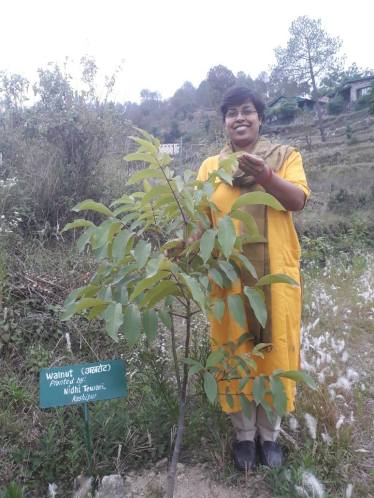
Apart from her regular work, Nidhi is also involved in several social development and upliftment initiatives at a personal level.
As per World Health Organisation, nearly half of the world’s population, some 3 billion people, still rely on solid fuels (wood, animal dung, crop residues, coal) for their everyday household energy needs. Much of this fuel is burned in open fires and simple stoves with poor ventilation, leading to very high levels of smoke exposure – particularly for women and young children[1].
In rural and low-income urban households, energy is a woman’s business. She is responsible for providing energy, and use it for domestic chores and productive activities. A typical biomass cookstove/ Chulha releases 400 cigarettes per hour worth of smoke negatively impacting health.
It is generally seen that the percentage of people using solid fuel slowly declines with development alone requiring no special policies. However, in India, the absolute number of people exposed to smoke from solid fuel burning in their kitchens had not declined. In 1980 about 700 million people were using biomass-based chulha, in 1990 and in 2010 the number was still the same.
For several decades NGOs and the government worked on providing improved chulhas with limited or no success. Somehow rural women were not excited about the improved cookstove, though it was more efficient (burning was better and more complete).
Unlike solid fuels, LPG is a cleaner fuel as it does not produce any smoke. It is also more convenient to use and helps save time spent on cooking.
Since 1st May 2016, India has been in the midst of the world’s largest household energy transition, to date. Under Pradhan Mantri Ujjwala Yojana free LPG connections have been provided to 8 crore women from BPL families. The connection is in the name of the woman. The LPG subsidy is transferred to her bank account only. The LPG connection is exactly the same as that in a middle-class house- same regulator and same suraksha hose pipe, same colour and same size cylinder.
To sum up, as a clean fuel for cooking is adopted, women and children become healthier (more capacity) as the quality of indoor air improves, women are financially included (bank accounts) and women and young girls are able to put the time they save in collecting fuelwood and cooking on traditional chulha in more productive and more valued pursuits. (e.g. girl child education, farming, Skill development, MGNREGA, Self-help groups, and collective and individual enterprises), thus leading to their development.
About Nidhi Prabha Tewari
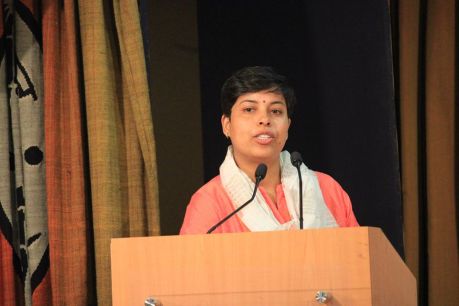
Nidhi Prabha Tewari works as a Senior Social Sector Specialist, Pradhan Mantri Ujjwala Yojana, Ministry of Petroleum and Natural Gas, Government of India. Ujjwala is the largest clean cooking fuel energy transition programme in the world.
She is also a Facilitator and Coach in Causing Incredible Performance- a homegrown framework for causing a quantum jump in performance in any field of life.
She is an Ashoka Fellow, International Visitor Leadership Programme Fellow, and a Visiting Fellow at Development Management Institute, Patna. She has experience in working with governments, MPs, academic institutions & NGOs. She has been doing policy/legislative research, leadership training & participatory field studies in the areas of democracy & development. She has a degree in Rural Management from Institute of Rural Management, Anand, and a post-graduate degree in Economics.
She has worked for disaster rehabilitation in Kutch Earthquake (2001), Tsunami (2004) Kashmir Earthquake 2005 & Bihar floods (2008). She also dabbles in running a hill resort in Uttarakhand.
All views expressed by the author are personal.
[1] https://www.who.int/indoorair/publications/symposium/en/
 INCREDIBLE WOMEN OF INDIA