Rituparna Ghosh, The Friendly Neighbourhood Coach
I don’t want a lot for Christmas
There is just one thing I need
I don’t care about the presents underneath the Christmas tree
All I want is some time,
If 48 hours a day could be mine…
If I had a penny for every time, I wished for 48hr days, I’d be a billionaire. This is probably an ideal place to insert the reality vs expectation memes. There is so much I want to do, plan the perfect birthday party for my son, plan for our travels, ensure the family is fed and taken care of, be active in groups to get more clients, create posts on Instagram, write that story which has been twirling around in my head, find time to go on a walk…. The list is never-ending. So much so the other day I asked the husband if we can incorporate a timekeeping system for household stuff because I have no idea where the time goes. The need for more time is universal, how many times you’ve said no to things that you love to do because of lack of time. With the advent of Covid, when the world shrunk into the four walls of the home, I’d thought I’d now have more, but suddenly there is a race against time to get even the basic tasks done.
What if I were to tell you, it’s possible to get more hours in a day?
No, it is not magic, but it’s more about how you can manage your 24 hours to get the illusion of having more. And it is no herculean task, you can achieve it by following a few simple steps.
- To do lists – Yup! Contrary to what anyone says, to-do lists are a must. It frees up a lot of brain space when you don’t have to remember what needs to be done next. For years I just made a to-do list for work and relied on memory for the house-related tasks. Having a curious child changed it all! Suddenly I was having to remember how many oceans are there in the world (5 if you are curious) and remember hymns (#tistheseason). I love these conversations, but my brain is constantly on overload having to remember it all. The to-do list is the magic wand here, I write down as and when I remember anything. Even if it is sometimes as basic as remembering to water the plants (No judgements, plant killer).
- Take charge – You own your time. Most often than not we are reacting to things than acting on them. I wake up in the morning with a brilliant story idea and then open ‘Whats App’ and see a barrage of things that needs to get done. I get so caught up with them that before long it’s evening, and I’ve not even begun. I find myself getting engaged in activities that are neither urgent nor important just because of a conversation or an ask. A couple of days ago, in the middle of a busy workday, I found myself setting up a Facebook group for someone. Was the group required? Yes, but did it need to be done when I had a long list of tasks that I wanted to get to? No.
It’s very easy to fall into the trap of, yeah this will be quick and let us get it done. But what purpose is it serving, if you go to bed missing out on a couple of tasks that were important and needed to be done?
- Plan your tasks – A fellow coach once told me that she distributes her to-do list across four quadrants.
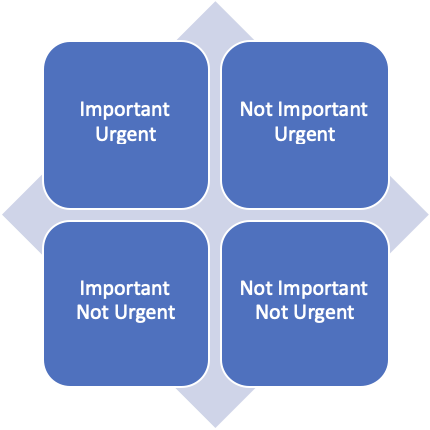
And anytime she thinks of a task, she immediately classifies it under one of these quadrants. She then blocks a few hours a day to get through the tasks, deliverables that are important and urgent (work-related, bills related, event-related). Then she blocks time to-do lists of Important but not urgent (Exercising, spending time with family etc…) and breaks them with the remaining tasks based on the available time.
- Analyse your time – Before allocating time towards your tasks, it is very important to know how much time would each task take? Might sound geeky, but works. The most common thing we end up doing is to allocate a task or an activity lesser time than it deserves. Post pandemic, my cooking time has grown 1.5 times. It took me a while to realise that. I was still cooking three meals a day, but instead of just cooking for me I had to now cater to the family, which even though was the same stuff but included more quantity hence more prep time. Researching and learning new things is usually something I take pride in. However, it also is my biggest time consumer, while sitting down to research for an article, I’d go down the jungle of knowledge. I have lost track of several times when research on minimalism has landed me on an excel sheet planning for a trip to Japan. There is no right or wrong way of doing things, I love reading, so I buffer for distractions as well as time them.
- Get to things that you don’t like doing – I often tell my 6 yr old, to survive on eating chocolates, he must first build his strength by eating his greens and fruits. My parenting style might be questionable, but there is a learning point there. We often procrastinate on tasks that are uninteresting, time-consuming or downright boring. We want to skip to the good part, but we forget that every good thing takes time and effort and is filled with activities that we don’t like. Writing ‘Unloved in love’ though very exciting, had me tearing out my hair when I had to sit and make characters outline, I hated having to visualise Kiara, Karan and Kyle when I didn’t even know where the story was headed. But by the time my thirteenth draft rolled out, I was glad I made them because it just made the story flow naturally. Which was a blessing, considering I was also working for my coaching certification.
- Focus on a single task – Women are multitaskers, I have lost count of the number of times my husband has commented to be awed by the number of things I manage to get done. Until recently I was fairly proud of being called a multitasker. However, I have slowly begun to realise that it is not such a good thing! Science firmly believes that humans are mono-taskers, our brain can only support one activity at a time. When we do two activities together, we are just doing each in quick succession with the other. Studies show that when our brain is constantly switching gears to bounce back and forth between tasks, it exhausts our brain faster and we become less efficient and more likely to make a mistake. A recent article by Forbes magazine also suggests human IQ gets lowered with multitasking. As contrary it sounds, the art of getting through to your to-do list is to actually do it one at a time.
- Control Social-Media and binge-watching – I am sure you have heard many times that SM is both a bane and boon of our generation. While it might not hold true for everyone, but a lot of us turn to SM to de-stress. It’s very natural to say, take five after completing a complicated task. But are the five minutes, really five minutes? Before long you find yourself drawn into reels after reels, or some interesting video of 5-minute hacks, there is your 30 minutes wasted. Which if we could spend exercising, our knees would thank us one day! Binge-watching OTT is in, it’s what the millennials and Gen Z identify as chilling. But do you know, binge-watching gives your brain a dopamine hit, which is the same as a hit from taking drugs? Okay probably an extreme view to take, but recent studies show binge watching interferes severely with sleep and is the cause of almost 50% of ailments like anxiety and depression, back problems, respiratory function and lack of physical activity.
As Master Oogway says ‘Yesterday is history, tomorrow is a mystery, and today is a gift…that’s why they call it present.’ Using our time purposefully would not only help us achieve more but be more in tune with our ambitions and aspirations. Imagine that feeling when you do not have to race against the clock, but walk with it hand in hand as old friends?
So, what are you going to do today?

 INCREDIBLE WOMEN OF INDIA